
Last updated October 16, 2026
 Wrought iron
 Wood & steel frame
 Farm & ranch
 Sliding driveway gates
 LiftMaster operators
Free on-site gate assessment - hinges, posts, and your LiftMaster or Nice gate operator checked before anything is quoted
The assessment is free and the quote is the invoice.
Get your free estimateGate Repair Permits, Codes & Inspections in FL: What You Need to Know
A Fort Lauderdale homeowner who replaces a failed LiftMaster gate operator without a permit isn’t just risking a fine. They’re creating a title disclosure problem that can delay or kill the sale of their home years later. This guide walks through which gate repairs in Broward County need a permit, which don’t, and why the distinction matters more than most people realize. For a broader look at maintaining your entry system, see our Gate Repair services. We’ll cover Florida Building Code Section 1008, entrapment protection, HOA approvals, insurance inspections, and how to check your own property’s permit history.
Styles & brands we work with
Quick Answer
In Fort Lauderdale and across Broward County, most gate repairs (replacing a circuit board, swapping a failed safety edge, rewiring a photocell) are exempt from permitting. But gate replacement, gate motor replacement, and adding an automatic opener to a previously manual gate are permitted work items under Florida Building Code and Broward County amendments. Before any work starts on those jobs, you need a permit pulled by a licensed contractor, the work inspected, and in many HOAs, written pre-approval from the association. Skipping this creates problems that surface during home sales, refinances, and 4-point insurance inspections. For Gate Repair Warning Signs: A Fort Lauderdale Homeowner’s Reference Guide, check our blog.
Table of Contents
- Repair vs. Replacement: Where the Permit Line Actually Sits
- Broward County Permit Requirements for Gate Work
- How to Check If a Previous Gate Installation Was Permitted
- Florida Building Code Section 1008 and Automated Gate Safety
- Entrapment Protection: What Inspectors Actually Check
- The HOA Dimension: Approval Independent of City Permits
- How Unpermitted Gate Work Affects 4-Point Insurance Inspections
- Common Mistakes to Avoid
- When to Call a Professional
- Frequently Asked Questions
- The Bottom Line
Repair vs. Replacement: Where the Permit Line Actually Sits
The single most useful thing a Fort Lauderdale homeowner can learn about gate permits is the difference between a repair and a replacement. The line is specific, and it determines whether you need to involve Broward County’s building department at all.
A repair restores existing equipment to working condition without changing its function, footprint, or power draw. Replacing a broken gear in a BFT swing motor, swapping a worn hinge bushing on an existing gate leaf, rewiring a photocell that corrosion ate through, or replacing a failed Viking control board all count as repairs. Under Florida Building Code and Broward County’s local amendments, these are exempt from permitting. The equipment is already there. You’re restoring it, not changing it.
A replacement changes what’s installed. Replacing a gate motor, in the way the code reads, is a replacement, not a repair. The same applies to replacing the entire gate structure, changing the gate’s size or material, or converting a manual gate to an automatic one. These jobs require a permit because they change the characteristics of the installation: the load on the foundation, the force the operator exerts, the safety devices required by Section 1008, and the electrical circuit feeding the motor.
The distinction surprises people. Replacing a failed gate motor with the same brand and model feels like a repair, and plenty of homeowners assume it is. But Broward County treats a motor swap as replacement work because the new operator has to be verified against current safety standards, not the standards that applied when the original was installed. A Linear operator installed 15 years ago may not meet today’s entrapment protection requirements, and the building department has no way to verify that without an inspection.
In practice, we’ve seen unpermitted motor replacements surface during home sales in Fort Lauderdale neighborhoods like Victoria Park, Rio Vista, and Coral Ridge. When the buyer’s inspector checks the permit history on the Broward County portal and finds a Ghost Controls operator that appears nowhere in the records, it becomes a negotiation problem. The seller either pays to pull the permit retroactively, pays for a repair that brings the gate into compliance, or loses the deal.
Broward County Permit Requirements for Gate Work
Broward County follows the Florida Building Code with local amendments, and Fort Lauderdale operates under that framework. Here’s what actually triggers a permit for gate work:
- New gate installation: Any new gate, whether manual or automatic, requires a permit. This includes driveway gates, pedestrian gates, and estate gates.
- Gate motor replacement: Swapping a failed or outdated motor for a new one is a replacement, and it requires a permit and inspection.
- Converting a manual gate to automatic: Adding an operator to a gate that was previously manual is a significant change. It brings the entire installation under Section 1008’s automated gate requirements, including entrapment protection, and it requires a permit.
- Structural modifications to the gate: Changing the gate’s dimensions, weight, or material affects the foundation and the motor’s load rating. Permitted work.
- Electrical work for the operator: Running a new circuit, upgrading the supply, or installing a new disconnect switch falls under electrical permitting requirements.
What does not require a permit:
- Motor repair: Rebuilding a gearbox, replacing a capacitor, swapping a control board on the existing motor. The motor stays in place; it’s repaired, not replaced.
- Safety device replacement: Replacing a failed photocell, safety edge, or loop detector with a compatible unit on an existing system.
- Gate adjustment and alignment: Realigning a sagging gate leaf, adjusting limit switches, tuning the operator’s force settings.
- Lubrication and routine maintenance: Greasing hinges, tightening bolts, cleaning tracks.
One useful rule of thumb: if the work changes what’s permanently attached to the property, it probably needs a permit. If it restores what’s already there, it probably doesn’t. When there’s doubt, the Broward County Permit Center at 1 N. University Drive in Plantation can answer questions, or your licensed gate contractor can confirm before work begins.
We’re a Warden Gate Repair Fort Lauderdale home specialist, and we handle this process for our clients: the permit application, the inspection scheduling, and the paperwork. It’s part of the job, not an add-on.
How to Check If a Previous Gate Installation Was Permitted
If you bought your Fort Lauderdale home with a gate already installed, you may not know whether the previous owner permitted the work. That question matters when you sell, refinance, or file an insurance claim. Here’s how to find out.
Step 1: Access the Broward County permit portal. Go to the Broward County Building Code Division’s online services page and find the permit search tool. You can search by address, and it covers work permitted in unincorporated Broward County and in cities like Fort Lauderdale that participate in the county’s system.
Step 2: Search your property address. Enter the full street address exactly as it appears on your property tax records. The system returns all permits on file for that address, including electrical permits that may cover your gate operator’s power supply.
Step 3: Look for gate-specific permits. Gate work often falls under a miscellaneous permit, a fencing permit, or an electrical permit depending on the scope. Search terms to look for in the permit descriptions include “gate,” “operator,” “automatic gate,” “swing gate,” or “sliding gate.”
Step 4: If the portal shows nothing, contact the city directly. Fort Lauderdale’s Building Services division can pull records that may not appear in the online index, especially for work done before the county digitized its records. Call them, give the address, and ask specifically: “Is there a permit on file for a gate or gate operator installation?”
Step 5: Compare against what’s actually installed. If the records show a manual gate permit from 2004 but the property now has a BFT automatic swing gate, the operator was added later without a permit. Or if there’s no permit record at all but the gate is clearly not original construction, you’re looking at unpermitted work.
We’ve handled this situation for homeowners in Fort Lauderdale’s older neighborhoods, where gates date back decades and records are patchy. If the previous work wasn’t permitted, it’s usually fixable, but the fix costs less and goes smoother when it’s done on your timeline rather than during a sale contingency period.
If you need help understanding what your permit history means for your gate, our Gate Repair in Fort Lauderdale team can walk you through it.
Florida Building Code Section 1008 and Automated Gate Safety
Florida Building Code Section 1008 governs gates that are part of a building’s means of egress. But the section also applies to vehicular gates in specific ways, and the Florida-specific amendments add requirements that homeowners should know about.
Section 1008 covers two key things for your gate. First, pedestrian gates that serve as part of an exit path must open with a single operation, no special knowledge, and no more than 15 pounds of force. If your pedestrian gate sticks, binds, or requires you to lift while turning the handle, it’s non-compliant. Second, vehicular gates must have entrapment protection systems that stop and reverse the gate when something blocks its path.
Florida’s amendments, combined with the ASTM F2200 standard that the code incorporates by reference, set specific requirements for automatic gates:
- Force limitation: The gate operator must limit the force it applies to the gate leaf, so that contact with an obstruction triggers a stop and reverse rather than continuing to push.
- Entrapment protection devices: Automatic gates need external entrapment protection, typically photocells (photo eyes) at a minimum, and in many cases, safety edges or contact sensors on the leading edge of the gate.
- Warning signs: Vehicular gates require warning signs on both sides, visible to anyone approaching the gate.
- Disconnect requirements: The operator needs a dedicated disconnect switch that cuts power for maintenance and emergency situations.
- Maximum gate speed and weight limits: The operator must be rated for the gate’s weight and speed. A motor that’s too small for the gate leaf is a code violation, not just a maintenance problem.
When you replace a gate motor in Fort Lauderdale, the inspection verifies that the new installation meets these requirements. That’s one reason why a motor swap is permitted work: the inspector is confirming that the new operator, the safety devices, and the gate structure all work together safely. An unpermitted motor replacement skips that verification.
We service Viking, BFT, Linear, and Ghost Controls operators regularly, and we’ve seen older installations where the safety devices were removed, disabled, or never installed to begin with. Those systems are dangerous, and they’re exactly what the inspection process is designed to catch.
For more on the electrical side of this work, see our guide to Electric Gate Repair in Fort Lauderdale.
Entrapment Protection: What Inspectors Actually Check
Entrapment protection is the most inspected element of an automated gate in Broward County, and it’s the area where DIY and unpermitted installations most often fail. An inspector follows a specific checklist, and it helps to know what they’re looking at.
- Photocells present and positioned correctly. The inspector verifies that the photo eye is mounted at the right height, aligned so the beam actually crosses the gate’s path, and wired to stop the gate when interrupted. Photocells that are zip-tied to a fence post, pointed at nothing, are an instant failure.
- Safety edges or contact sensors in place. Many swing gates and sliding gates require a physical contact edge on the gate itself that reverses the gate when it presses against something. The inspector checks that the edge is intact, not cracked or compressed from age, and properly wired to the operator’s control board.
- Entrapment zones identified and protected. Swing gates have specific entrapment zones at the hinge post and at the closing edge. The inspector checks that protection exists for each zone that’s reachable from the property or the street side.
- Force test. The inspector performs or observes a force test, which measures the force the gate exerts before reversing. Above the limit, the gate fails. This test catches operators that are too powerful for the gate they drive.
- Warning signs mounted. ASTM F2200 requires specific warning signs on vehicular gates. The inspector looks for them, and their absence is a genuine finding.
- Manual operation works. The gate must be manually operable in a power failure. The inspector will disengage the operator and verify the gate can be moved by hand.
If any of these fail, the inspector will not sign off on the installation, which means the permit stays open. For the homeowner, an open permit is as problematic as no permit at all: it creates the same disclosure problem during a sale, and some insurance carriers treat an open permit on record as a red flag.
We correct failed entrapment protection systems for homeowners across Fort Lauderdale all the time. It’s one of the most common reasons a gate doesn’t pass inspection after a DIY or unpermitted motor replacement. The fix usually involves installing proper photocells, wiring safety edges, and re-testing the operator’s force settings.
If you’re dealing with a failed inspection or want to know whether your gate would pass one, our Gate Motor Repair in Fort Lauderdale service includes a full safety-device assessment.
The HOA Dimension: Approval Independent of City Permits
Fort Lauderdale has a high concentration of HOA-governed communities, and many of them impose gate rules that operate completely separately from Broward County’s permitting process. A county permit says the work meets code. An HOA approval says the work meets the community’s aesthetic and architectural standards. You need both.
Most HOAs in Fort Lauderdale require pre-approval before any change to a gate’s appearance, size, material, or configuration. That includes repainting, replacing a wooden gate with aluminum, changing the style, or adding an automatic opener to a manual gate. Some HOAs have specific rules about gate heights, setback from the street, and even the brand of operator they’ll allow.
The process usually works like this:
- Review the HOA covenants and architectural guidelines. Find the section that covers gates, fences, or exterior modifications. It will tell you whether gate changes require approval and what the approval process is.
- Submit the required application. Most HOAs use an architectural review committee (ARC) that meets monthly. Include the full scope of work, the gate design, the operator specifications, and, if required, drawings or photos.
- Get written approval before any work starts. A verbal “should be fine” from a board member is not approval. Written approval is what protects you if the board changes its mind or a neighbor complains.
- Attach the HOA approval to the permit application if required. Some Fort Lauderdale HOAs require proof of ARC approval before their management company will sign off on anything, though the county doesn’t require it.
The failure mode we see most often is a homeowner who gets county permits, completes the work, passes inspection, and then discovers the HOA never approved the gate change. The HOA can issue fines, demand removal or modification, and place a lien for non-payment. It’s a legitimate mess, and it’s entirely avoidable with a simple written request before the work starts.
How Unpermitted Gate Work Affects 4-Point Insurance Inspections
Florida homeowners know the 4-point inspection: roofing, electrical, plumbing, and HVAC. Gate work doesn’t get its own section, but it falls under the electrical and general safety review, and unpermitted gate installations are increasingly flagged by inspectors doing these reports.
A 4-point inspector looks at the home’s major systems and identifies conditions that create risk for the insurer. An automatic gate operator attached to a breaker circuit with no permit on record is an unpermitted electrical modification, and that shows up in the report. The inspector can’t verify the work was done to code, so they note it as inaccessible or unverifiable, and that note travels to the insurance carrier.
Insurance consequences vary by carrier. Some decline to write a policy when unpermitted work is disclosed. Others write the policy but exclude the gate from coverage, which means gate-related damage is uninsured. A few issue the policy with a condition that the unpermitted work be remediated within a specific period. In all cases, the unpermitted gate becomes an obstacle at the worst possible time: during underwriting, when the homeowner is trying to close on a purchase or renewal.
It’s worth noting that a properly permitted and inspected gate installation is a non-issue for 4-point inspections. The inspector sees the permit on file, the work was verified, and the report moves on. The permit is the difference between a clean underwriting and a flagged one.
Fort Lauderdale’s housing stock includes a lot of homes built in the 1950s through 1980s, and many of those homes had gates added much later. The older the home, the more likely a gate was installed or replaced without a permit at some point, simply because the equipment wore out and someone swapped it without thinking through the paperwork.
We regularly help homeowners in this exact situation: the 4-point inspection came back with a flag on an unpermitted gate operator, and they need the work permitted retroactively or the equipment brought into compliance. It’s a solvable problem, but it’s faster and cheaper when addressed proactively.
Common Mistakes to Avoid
- Assuming a motor swap is a repair, not a replacement. Replacing a failed gate motor is replacement work under Broward County’s interpretation of the Florida Building Code. It requires a permit, an inspection, and verification of entrapment protection. Treating it as a simple part swap creates a future title disclosure problem.
- Hiring an unlicensed handyman for automatic gate work. Gate operators connect to line voltage, and a handyman without an electrical or gate license isn’t qualified to run the circuit or pull the permit. The work may work, but it won’t be permitted, and the liability rides on you.
- Skipping HOA approval because it seems like a formality. Every year, we hear from Fort Lauderdale homeowners who got county permits but never asked their HOA, and now face demands to remove or alter a perfectly good gate. Get HOA approval in writing first.
- Believing a home warranty covers unpermitted work. Home warranty companies deny claims for unpermitted installations all the time. If the gate motor fails and there’s no permit on record, the warranty provider has grounds to decline.
- Waiting until a sale to resolve permit issues. An unpermitted gate that surfaces during a 4-point inspection or title search creates a contingency problem. Buyers demand credits, repairs, or permit retrofits, and the seller has no negotiating leverage. Fix it on your own timeline instead.
- Replacing a motor without verifying entrapment protection compatibility. A new motor requires verification that the existing safety devices are compatible and functional. If the photocells are ancient or the safety edge is missing, the installation won’t pass inspection, and the permit will stay open.
- Disabling safety devices to solve nuisance tripping. Photocells that trip when a branch sways or safety edges that reverse the gate when it gets hot are annoying. Disabling them is dangerous and illegal, and it’s the first thing an inspector catches when they look at an installed gate.
When to Call a Professional
Some gate work is genuinely DIY-friendly: lubricating hinges, tightening hardware, replacing a keypad battery. The moment the job touches the motor, the electrical supply, or the gate’s structural attachments, you’re in professional territory. That’s true for code compliance reasons and for safety reasons: a gate motor under load can exert force that causes serious injury, and the electrical circuit feeding it is no different from any other line-voltage circuit in your home. If you’re considering a motor replacement, converting a manual gate to automatic, or addressing an entrapment protection failure, get a licensed contractor to do the work, pull the permit, and stand behind the inspection. See How to Hire a Gate Repair Contractor in Fort Lauderdale: A Step-by-Step Guide for help choosing the right professional. Warden Gate Repair Fort Lauderdale offers free estimates in Fort Lauderdale, and we handle the permit and inspection process as part of the job. Call (754) 354-9065.
Frequently Asked Questions
Yes. Replacing a gate motor in Fort Lauderdale is classified as replacement work under Broward County’s application of the Florida Building Code, and it requires a permit and inspection. Repairing the existing motor, such as replacing a capacitor or control board, does not require a permit. Call (754) 354-9065 if you’re not sure which category your job falls into.
No. Converting a manual gate to an automatic gate is permitted work in Fort Lauderdale, and it brings the entire installation under Florida Building Code Section 1008’s automated gate requirements, including entrapment protection devices and warning signs. The job also requires an electrical permit for the circuit feeding the operator.
Search your address on the Broward County permit portal, or call Fort Lauderdale Building Services and ask for the permit history on your address. Look for permits with descriptions including “gate,” “operator,” “swing gate,” or “sliding gate.” If nothing appears and your gate is clearly not original construction, the work was likely unpermitted.
Yes. A 4-point insurance inspection can flag an unpermitted gate operator as an unverifiable electrical modification, which may lead to policy conditions, coverage exclusions, or a declined application. A permitted and inspected gate installation is a non-issue for most carriers.
Yes, if your HOA’s covenants require architectural review for gates. The HOA approval is separate from the city permit, and both are required. Work completed without HOA approval can trigger fines, removal demands, and liens.
At minimum, a Broward County gate inspection verifies functional photocells, entrapment protection for each danger zone, proper warning signs, a working manual release, and a force test within the code’s limits. Missing or disabled safety devices are the most common reason a gate fails inspection. Call (754) 354-9065 for a free assessment.
The Bottom Line
Gate repair permits in Fort Lauderdale get confusing because the line between repair and replacement isn’t where most people expect it. Repairs are exempt. Replacements, conversions, and new installations are permitted. The practical consequences of getting it wrong ripple out: failed 4-point inspections, title disclosure problems, HOA fines, and worse. A permitted gate job with passing inspections is invisible in the best way, it never comes up again. An unpermitted one surfaces at the worst moment. Before work starts, verify what applies to your specific job, get the approvals in writing, and let a licensed contractor handle the permit. That sequence is the difference between a gate that protects your home and a gate that complicates your life.
Written by Cole Rafferty, Owner at Warden Gate Repair Fort Lauderdale, serving Fort Lauderdale since 2008.
See the difference
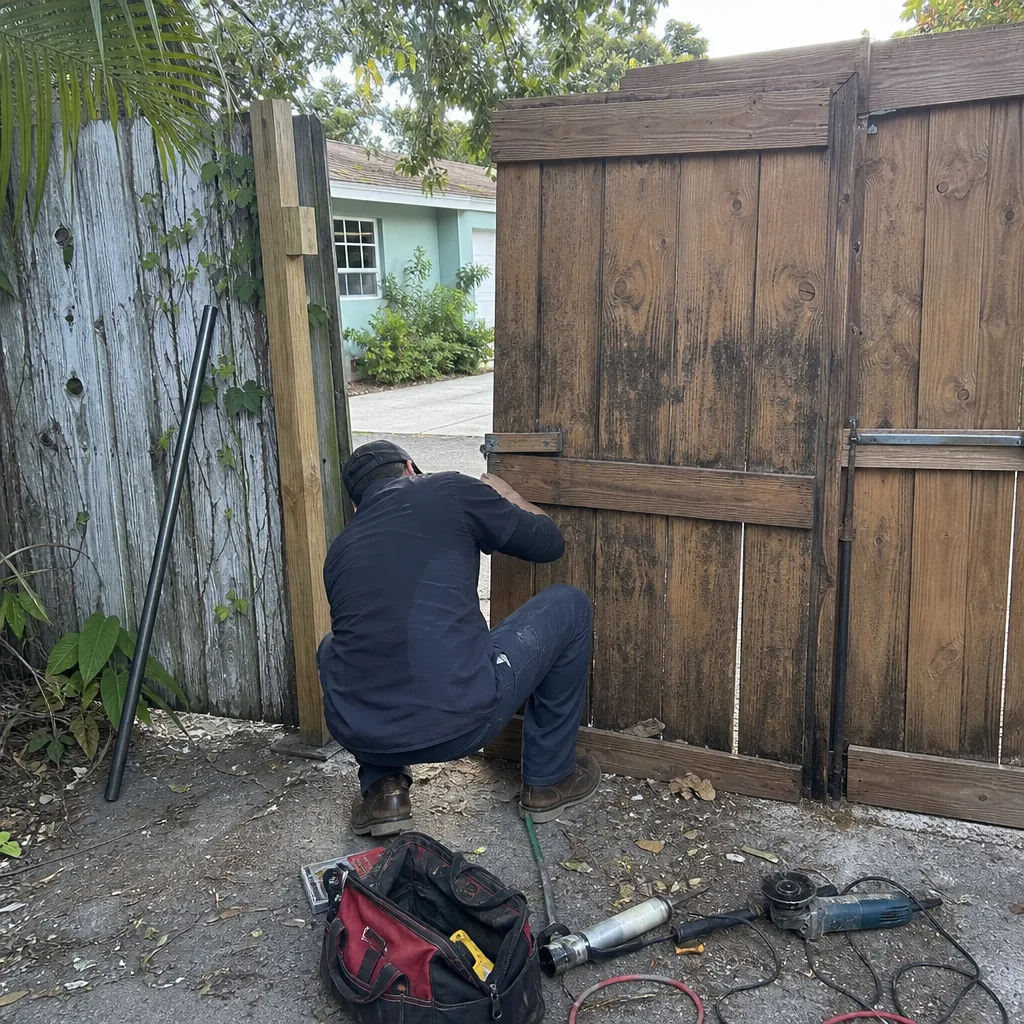 Before
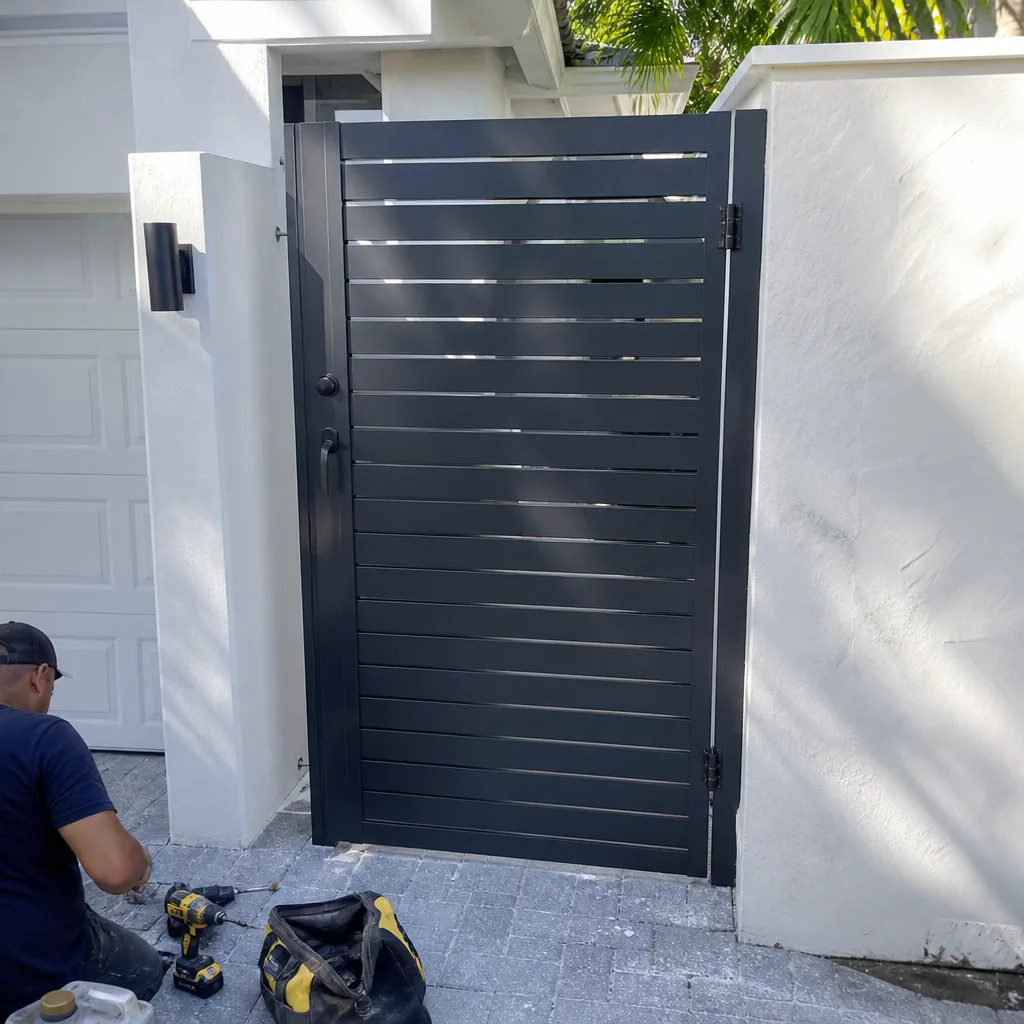 After
After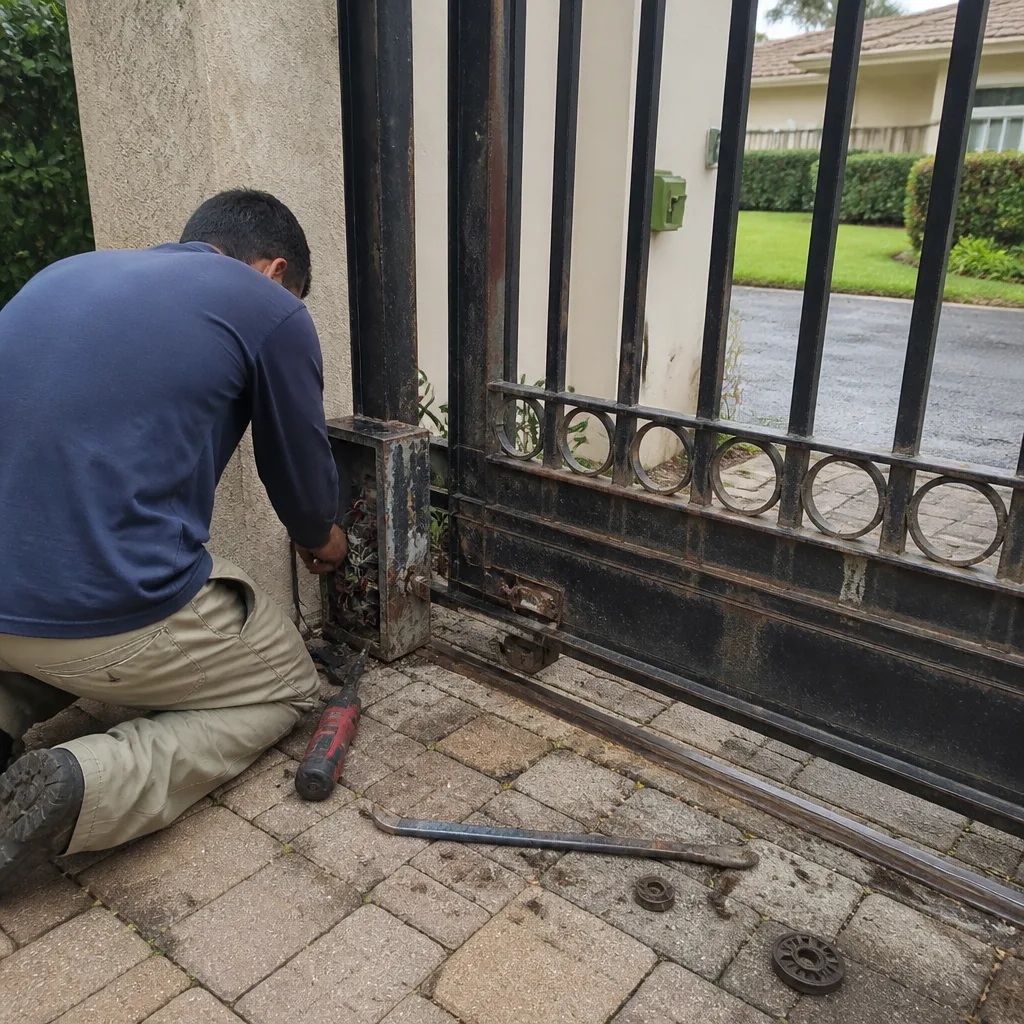 Before
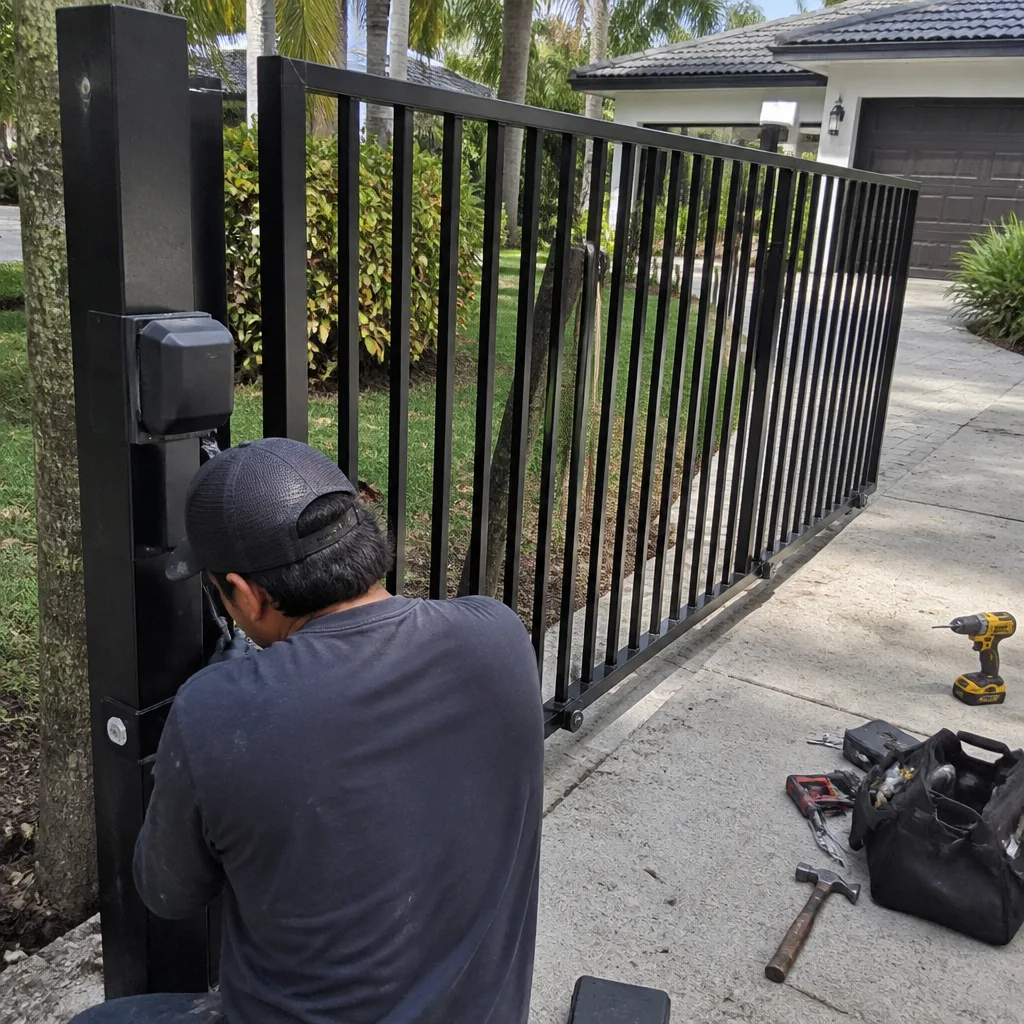 After
After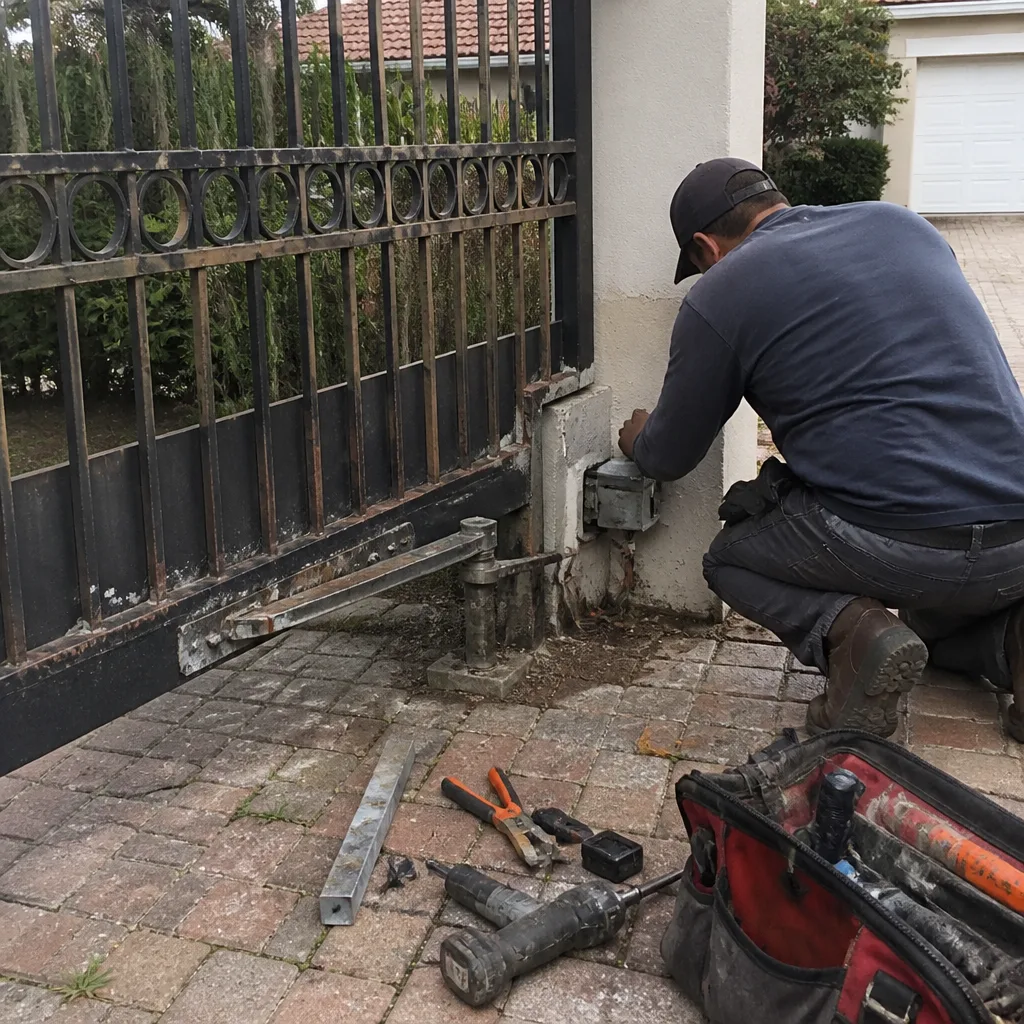 Before
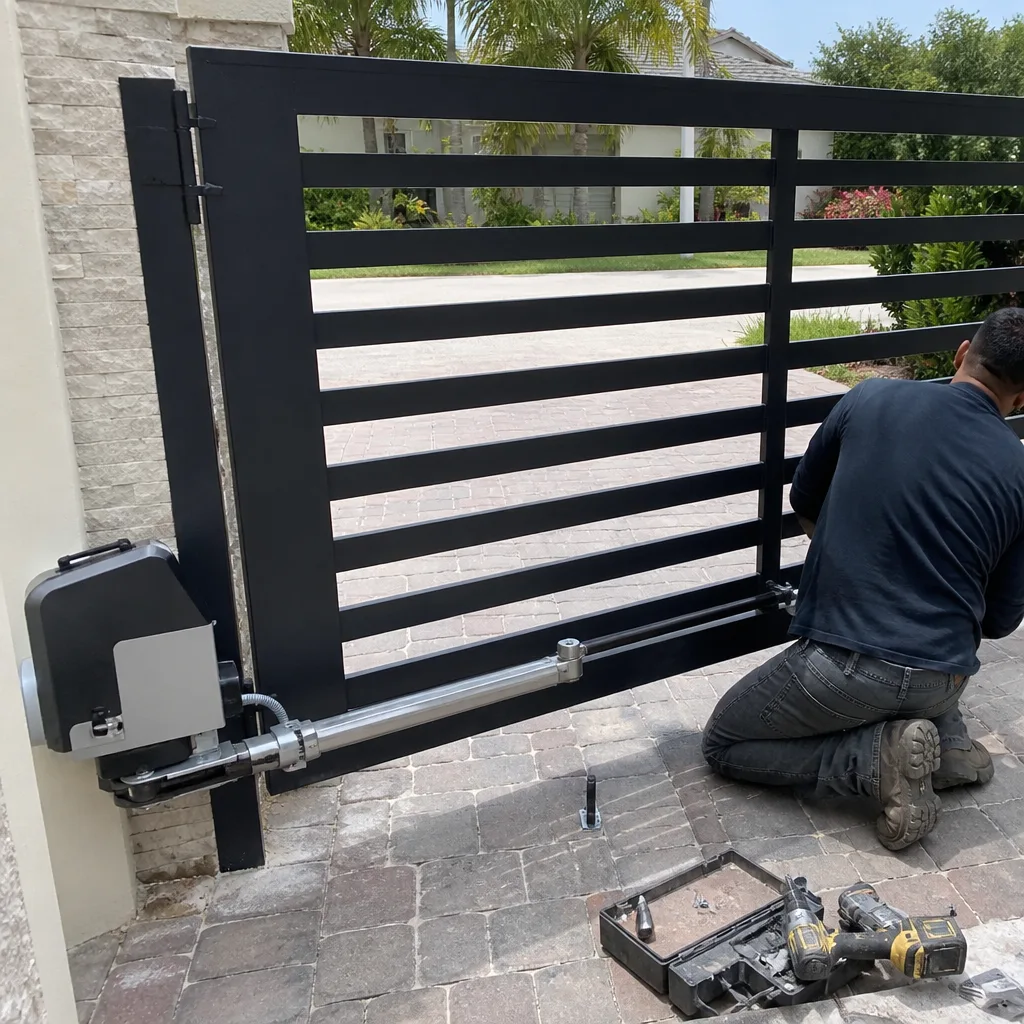 After
After