
Last updated October 16, 2026
 Wrought iron
 Wood & steel frame
 Farm & ranch
 Sliding driveway gates
 LiftMaster operators
Free on-site gate assessment - hinges, posts, and your LiftMaster or Nice gate operator checked before anything is quoted
The assessment is free and the quote is the invoice.
Get your free estimateDIY vs Professional Gate Repair: The Fort Lauderdale Homeowner’s Decision Guide
Here’s a number most Fort Lauderdale homeowners never see coming: a DIY gate motor replacement saves roughly $150 in labor on the day of the repair, but voids the manufacturer warranty, skips the Broward County permit requirement, and shifts full personal liability onto the property owner if that gate later injures a visitor, a delivery driver, or a child. The real cost of that $150 savings can exceed $15,000 in legal exposure alone. This guide walks you through exactly which gate repairs are genuinely safe to do yourself in Fort Lauderdale, which ones Florida law reserves for licensed contractors, and where the honest middle path lies. We’ll cover warranty traps, salt-air corrosion, permit requirements, and the liability math that most DIY guides never mention.
Styles & brands we work with
Quick Answer
Most Fort Lauderdale homeowners should handle three maintenance tasks themselves (lubricating hinges, cleaning photo eyes, testing the manual release) and leave everything involving the gate motor, electrical wiring, or new opener installation to a licensed professional. DIY work on a motor or electrical connection voids most manufacturer warranties, violates Broward County permit requirements, and creates personal liability under Florida premises law. The tasks that are safe to DIY are genuinely quick and simple; the tasks that require a pro are genuinely dangerous and regulated for a reason.
Table of Contents
- The Safe DIY List: What Any Fort Lauderdale Homeowner Can Handle
- The Pro-Only List: Florida Law and the Permission Problem
- The Warranty Voiding Trap Most DIY Guides Skip
- Why Fort Lauderdale’s Salt Air and Humidity Change the DIY Math
- The Liability Dimension: What Happens When a Self-Installed Gate Fails
- Broward County Permit Requirements for Gate Work
- The Honest Middle Path: What to Do Between Service Visits
- Cost Comparison: DIY vs Professional Gate Repair in Fort Lauderdale
- Common Mistakes to Avoid
- When to Call a Professional
- Frequently Asked Questions
- The Bottom Line
The Safe DIY List: What Any Fort Lauderdale Homeowner Can Handle
There are exactly three gate maintenance tasks that are genuinely safe for a Fort Lauderdale homeowner to do without tools beyond a rag, a can of lubricant, and ten minutes of attention. These tasks do not require opening the motor housing, touching wiring, or adjusting tension on springs. They also do not void any warranty on your LiftMaster, FAAC, or Mighty Mule opener, because no manufacturer considers routine surface maintenance a warranty issue.
First on the list is lubricating hinges and moving metal joints. In Fort Lauderdale’s salt-heavy air near the Intracoastal and the beach corridors, gate hinges corrode faster than in almost any inland Florida city. A proper silicone-based lubricant applied to hinge pins, the latch mechanism, and the chain drive (if your gate uses one) every three months will extend the life of those components by years. The key is using the right product. WD-40 is a solvent, not a lubricant; it strips away the protective film and accelerates corrosion within weeks. Use a marine-grade silicone spray, available at any hardware store in Fort Lauderdale for under $15. Apply it, open and close the gate two or three times, and wipe the excess.
Second is cleaning the photo eye sensors. These are the small lenses mounted near the bottom of the gate track or posts, usually one on each side of the opening. When Fort Lauderdale’s afternoon thunderstorms kick up dirt, mulch, and debris, those lenses get coated with a film that makes the gate think something is in the way. The gate refuses to close, and the homeowner thinks the motor is dead. In our experience, especially in neighborhoods like Victoria Park and Rio Vista with mature landscaping, photo-eye obstruction is the single most common cause of “my gate stopped working” calls to our Gate Repair services. Cleaning takes two minutes: wipe each lens with a dry cloth, then with a damp cloth, then test the gate. If it still doesn’t close, the sensors may be misaligned, and that is where professional help becomes worth the call.
Third is testing the manual release mechanism. Every automatic gate has a manual release, which is the lever or pull-cord that disengages the motor so you can slide or swing the gate by hand during a power outage. Hurricane season in Fort Lauderdale makes this a monthly drill from June through November. You should know where that release is, how to operate it, and whether the gate moves freely when disengaged. This does not require opening the motor housing or disconnecting wires. It is a test, not a repair. If the gate does not move freely in manual mode, something is binding or bent, and that is a sign to call someone who works on gates every day. For guidance on keeping your gate in top shape, see our Gate Repair Maintenance Checklist for Fort Lauderdale Homeowners.
Those three tasks. That is the complete safe DIY list. Everything beyond this list involves either the motor, the wiring, the springs, or the structural mounting points, and that is where the physics and the law start to matter.
The Pro-Only List: Florida Law and the Permission Problem
Florida law draws a clear line between maintenance and construction, and gate repair crosses that line more often than most homeowners realize. Under Florida Statute Chapter 489, any work that involves electrical connection, structural modification, or the installation of a permanent mechanical system requires a licensed contractor. That means motor replacement, new opener installation, wiring repair, and any work on the gate’s structural support posts are not DIY territory in Fort Lauderdale, regardless of how many YouTube tutorials you have watched.
Here is the task-by-task breakdown:
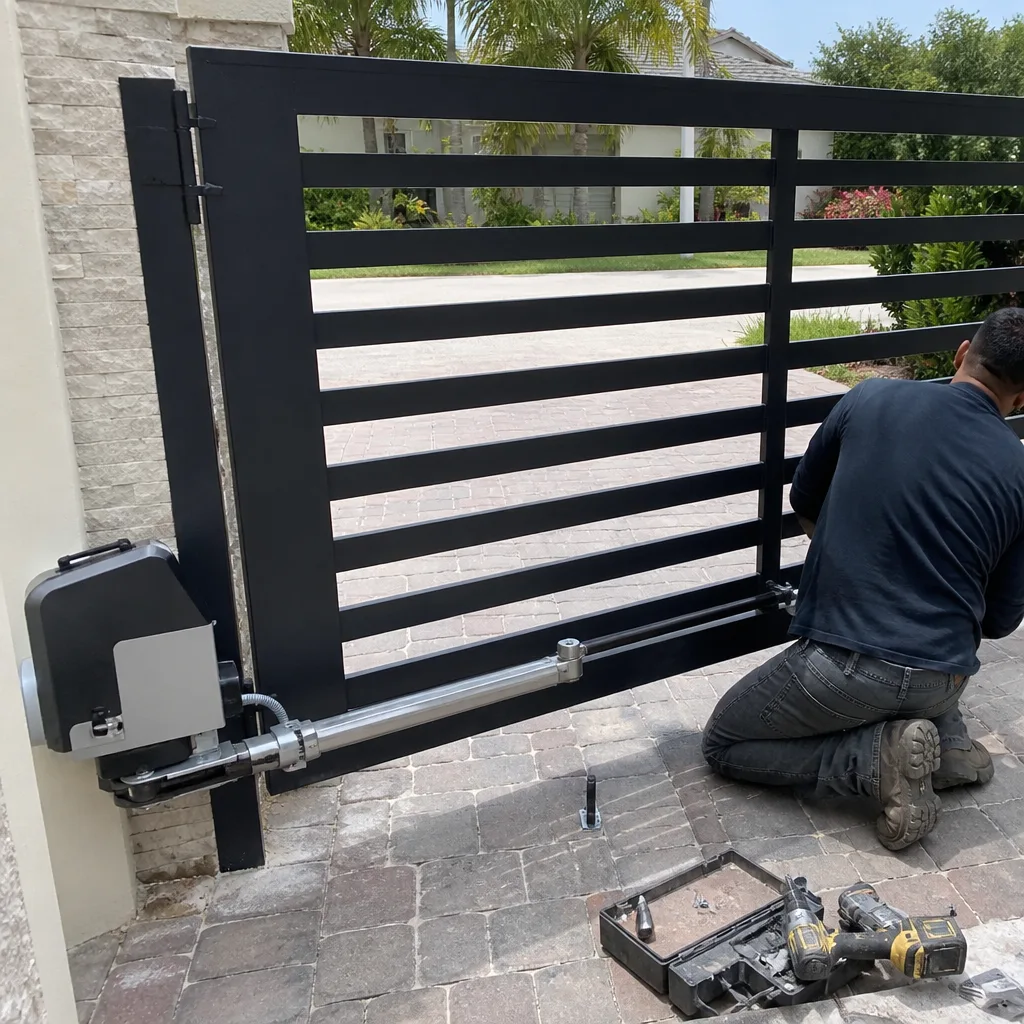
- Gate motor replacement: Requires disconnecting and reconnecting line-voltage wiring, which Florida law reserves for licensed electrical or specialty contractors. A LiftMaster or FAAC motor swap is not a plug-and-play job even when the old motor and new motor look identical. The mounting brackets, the torque settings, and the limit switches all need calibration against the specific gate weight and travel distance.
- New gate opener installation: A full opener install on a sliding gate involves mounting a concrete pad, running conduit, and connecting a dedicated circuit. In Broward County, this work requires a permit and a licensed installer. Unpermitted installations are a code violation that can complicate a future home sale and give an insurance company grounds to deny a claim.
- Wiring repair or replacement: Any repair that touches the line-voltage wiring, the low-voltage control wiring, or the electrical connections inside the motor housing is licensed work. The risk here is not just shock; a loose wire in a gate control board can cause the gate to operate erratically, which is worse than not operating at all.
- Spring tension adjustment: Some swing gates use heavy torsion springs to counterbalance the gate leaf. These springs are under enormous tension and can cause serious injury if they release while someone is adjusting them. This is not a maintenance task.
- Structural repairs to posts, hinges, or mounting plates: When a gate sags or a post leans, the fix is not a new bolt. The post needs to be reset in concrete, and the hinge position needs to be re-engineered for the gate’s weight. Fort Lauderdale’s sandy soil and high water table mean post foundations shift over time, and a sagging gate in neighborhoods like Coral Ridge or Imperial Point is usually a foundation problem, not a hinge problem.
The pattern here is straightforward: if the repair involves the motor, the wires, the springs, or the structure, it is licensed work. If it involves cleaning, lubricating, or testing surfaces, it is homeowner work. The line is not about skill; it is about safety, code, and liability.
The Warranty Voiding Trap Most DIY Guides Skip
The most expensive mistake a Fort Lauderdale homeowner can make with a gate repair is doing the work and then discovering that the $150 they saved in labor cost them a $400 to $1,200 warranty claim. LiftMaster, FAAC, BFT, and most other gate opener manufacturers write their warranty agreements with an explicit clause: the product must be installed and serviced by a qualified professional. A homeowner who swaps their own motor has, in the manufacturer’s view, voided the warranty on the spot.
Here is how the math actually works. You buy a replacement motor online for $500. The same motor purchased and installed through a professional costs $1,100, which includes the labor. You install it yourself and save $600. Six months later, the motor fails. The manufacturer asks for your proof of professional installation. You cannot provide it. The warranty is void, and you are buying another $500 motor and doing the work again. Your total outlay is now $1,000, you have spent two weekends on the project, and you still have a gate that does not work.
The same applies to warranties on the gate structure itself. Companies like DoorKing and Viking specify professional installation for their openers, and many Fort Lauderdale gate fabricators include a workmanship warranty on the gate that becomes void if an unlicensed person modifies the gate or its operating system. What looks like a simple motor swap to the homeowner looks like unauthorized modification to the warranty department.
The workaround is not to lie about the install. That compounds the problem, because now there is a written misrepresentation in the warranty record. The workaround is to read the warranty before you buy the part, not after the repair fails. If the warranty requires professional installation, the cost of professional installation is part of the cost of the part. That is the honest way to evaluate whether a DIY repair actually saves money in Fort Lauderdale, because the warranty clause is a real cost either way.
Why Fort Lauderdale’s Salt Air and Humidity Change the DIY Math
Fort Lauderdale does things to gate hardware that Midwestern gate repair guides never address. The combination of Atlantic salt air, 70-plus percent average humidity, and intense UV exposure means that the wrong repair product or technique fails faster here than anywhere in the continental U.S. except the immediate Gulf Coast. This matters because most DIY gate repair advice available online is written without any awareness of a coastal salt environment.
The lubricant issue is the clearest example. A homeowner in a dry climate can use almost any spray lubricant on gate hinges and get a year or two of smooth operation. In Fort Lauderdale, a petroleum-based lubricant applied to salt-exposed metal actually attracts and holds salt particles, creating a corrosive slurry that eats through hinge pins and bearing surfaces. We have seen gate hinges in Las Olas Isles and Harbor Beach corroded through in under two years because the homeowner applied the wrong product every few months with good intentions. The right product, a marine-grade silicone or a lithium-based grease, costs about the same and reduces the corrosion rate dramatically.
Humidity affects the electrical side of gate repair even more. Fort Lauderdale’s humid air condenses inside motor housings and control boxes overnight, and that condensation accelerates the death of capacitors, relays, and control boards. A DIY motor replacement that does not properly seal the housing, or that leaves a wiring gland loose, will fail within months in this climate. The failure is often intermittent at first: the gate works in the morning, stops working in the heat of the afternoon, works again in the evening. Homeowners chase these gremlins for weeks because the symptoms point everywhere and nowhere. A technician who works in Fort Lauderdale every day recognizes the condensation pattern immediately, because it is the single most common gate failure mode in this climate.
Salt air also means stainless steel is not optional. Homeowners who replace gate hardware with galvanized or zinc-coated parts from a big-box store are installing a clock that starts ticking immediately. In Fort Lauderdale’s coastal neighborhoods within two miles of the ocean, galvanized hardware on a gate can show visible rust within six months and structural weakness within two years. Marine-grade stainless steel, which is what any reputable gate company specifies for coastal installations, costs more but lasts the life of the gate.
The Liability Dimension: What Happens When a Self-Installed Gate Fails
Here is the part of the DIY-vs-professional conversation that almost no gate repair guide addresses, and it is the most important part for a Fort Lauderdale homeowner. If you install or repair your own gate motor, and that gate later malfunctions and injures someone, Florida premises liability law makes you personally responsible. Not the motor manufacturer, not the online retailer who sold you the part, not the YouTube creator who showed you how to do it. You.
Florida premises liability law holds property owners responsible for maintaining their property in a reasonably safe condition. A gate that fails to stop when an object is in its path, or that falls off its track, or that crushes a delivery driver’s hand between the gate and the post, is a premises defect. When the injured person’s attorney files the claim, the first question the insurance company asks is whether the gate was professionally installed and maintained. If the answer is no, because the homeowner did the work without a license and without a permit, the insurance company’s defense posture changes. Some policies contain exclusions for unpermitted work. Some coverage disputes center on whether the homeowner’s actions constituted negligence that voids the policy’s protection for that claim.
The dollar figures are not theoretical. A single gate-related personal injury claim in Florida can exceed $50,000 in medical bills alone, before attorney fees and pain-and-suffering damages. A wrongful death claim involving a gate failure can exceed $1 million. These are not numbers that appear on the YouTube tutorial or the part retailer’s product page, but they are the numbers a Fort Lauderdale homeowner is gambling with when they take on a motor replacement themselves.
Professional installation does not eliminate liability, but it changes where the liability lands. A licensed contractor carries their own insurance, and a permitted installation creates a paper trail that shows the work met code at the time it was done. In a premises liability dispute, that paper trail is the difference between a settled claim and a personal financial catastrophe. The $150 to $600 a homeowner saves on DIY motor work is not even close to the value of having that paper trail.
Broward County Permit Requirements for Gate Work
Broward County requires permits for gate work that involves electrical connection or structural modification. This is not a technicality and it is not enforced selectively; the county’s building department actively tracks unpermitted electrical work through its inspection records and through disclosure requirements at the point of home sale. For a Fort Lauderdale homeowner, the permit question is not “will anyone find out” but “what happens when they do.”
Here is what the permit process covers, step by step, for a typical gate motor replacement in Fort Lauderdale:
- Application: The licensed contractor files a permit application with Broward County, listing the scope of work, the equipment being installed, and the contractor’s license number.
- Plan review: For motor replacements and new opener installations, the county reviews the electrical connection plan and the load calculations to confirm the circuit and the motor are matched.
- Work performed: The contractor completes the installation, including the electrical connection, the mounting, the travel settings, and the safety features (photo eyes, reversing mechanism, audible alarm if required).
- Inspection: A county inspector visits the site, verifies the work against code, and signs off. The inspection record is what becomes the paper trail for future insurance claims and home sales.
A homeowner who does the work without this permit now owns an unpermitted electrical installation. The consequences vary depending on the circumstances: an insurance carrier may deny a claim related to the gate; a home inspection at sale may flag the unpermitted work and force either a retrofit inspection or a price concession; and the county can issue a stop-work order that becomes a lien if the work is not corrected. None of these consequences are hypothetical in Fort Lauderdale, where the real estate market is active enough that unpermitted work is routinely discovered during the disclosure process.
The permit cost itself is modest, typically in the $50 to $150 range for a gate motor replacement depending on the scope, and it is included in the professional’s quote. What the homeowner is paying for with a permitted installation is not the permit fee; it is the absence of the future liability that unpermitted work creates.
The Honest Middle Path: What to Do Between Service Visits
There is a legitimate middle path between full DIY and doing nothing between service visits, and it is where most Fort Lauderdale homeowners should live. The middle path means handling the three safe tasks above on a regular cadence, watching for early warning signs, and calling a professional before a small problem becomes a motor replacement.
The early-warning signs are specific and learnable. A gate that moves slower than it did last month is telling you something about the motor or the rollers. A gate that shudders or jerks when it opens is telling you something about the track alignment or the chain tension. A gate that reverses for no visible reason is telling you something about the photo eyes or the force settings. None of these are DIY fixes, but all of them are DIY detections. The homeowner who recognizes a warning sign and calls before the failure saves themselves the difference between a $200 adjustment and a $1,100 motor replacement.
The middle path also means keeping a simple log. Note the date you lubricated the hinges, the date you cleaned the photo eyes, and any change in gate behavior. When you call a professional, that log is genuinely useful diagnostic information. It tells the technician which components are degrading and how fast, and it shortens the troubleshooting time. In our experience, the homeowner who can say “the gate started slowing down about two months ago, and it is worse in the afternoon” gives us a thirty-minute head start on the diagnosis.
The middle path works because it respects the actual division between homeowner work and professional work. The homeowner owns the observation and the surface maintenance. The professional owns the motor, the wiring, the structure, and the liability. When both parties do their part, the gate lasts longer and the repair bills stay smaller.
Cost Comparison: DIY vs Professional Gate Repair in Fort Lauderdale
The most useful way to evaluate the DIY-vs-professional decision is with actual dollar figures from the Fort Lauderdale market, which we break down in our Gate Repair Cost Breakdown: The Fort Lauderdale Homeowner’s Reference for 2026. The numbers below reflect typical pricing for common gate repairs in this area as of current market conditions. They are ranges, not quotes; every gate is different, but the comparison between DIY and professional cost structures holds across the board.
Typical DIY vs Professional Costs by Task
- Hinge lubrication with marine-grade silicone: DIY cost $12 to $18 for the product, 10 minutes of time. Professional cost is not applicable; this is a homeowner maintenance task, and no one should pay a service call for it.
- Photo eye cleaning: DIY cost $0 to $5 for a cloth, 5 minutes of time. Professional cost $0 if included in a service call for another issue; $75 to $120 as a standalone service call.
- Gate motor replacement (LiftMaster, FAAC, BFT, or Mighty Mule equivalents): DIY cost $450 to $700 for the motor plus $50 for incidental hardware, 4 to 8 hours of labor if everything goes smoothly, plus the warranty void and the liability exposure. Professional cost $950 to $1,400 installed with permit, warranty protection, and liability coverage in place.
- New sliding gate opener installation: DIY cost $600 to $900 in parts plus concrete, conduit, and electrical supplies, an entire weekend, and no permit. Professional cost $1,800 to $3,200 depending on the opener brand and the gate weight, with permit, inspection, and warranty included.
- Control board replacement: DIY cost $200 to $400 for the board, 2 hours of labor if the homeowner can correctly identify the failed board and match the replacement part. Professional cost $400 to $700 installed, with the technician’s experience handling the diagnostic step that homeowners most often get wrong.
- Track alignment for a sliding gate: DIY cost $0 in parts, 2 hours of frustrating trial and error, and a high chance of making the alignment worse. Professional cost $150 to $350 for an adjustment service call.
The pattern is consistent: the bigger the job, the bigger the gap between what the homeowner saves and what the homeowner risks. The smaller maintenance tasks are true DIY savings with no downside. The larger repair tasks are the ones where the savings disappear into warranty voids, permit problems, and liability exposure.
Common Mistakes to Avoid
- Using WD-40 or another petroleum-based spray on gate hinges. In Fort Lauderdale’s salt air, petroleum spray becomes a corrosion accelerant. Use marine-grade silicone or lithium grease instead, and wipe away the excess after application.
- Opening the motor housing to “take a look.” The motor housing is where line voltage lives, and opening it without disconnecting power is how homeowners get shocked. It is also where warranties go to die if the manufacturer learns the housing was opened by an unlicensed person.
- Forcing a gate that resists manual operation. If the gate will not slide or swing freely in manual mode after disengaging the release, something is mechanically wrong. Forcing it damages the track, the rollers, or the hinge hardware, and turns a $200 adjustment into a $1,000 repair.
- Replacing a motor without checking the warranty terms first. The warranty clause is on the manufacturer’s website and in the product documentation. Read it before buying the part, not after the motor fails a second time.
- Ignoring slow gate movement as “just how it is.” A gate that gradually loses speed over weeks is sending a diagnostic signal. The cause is usually correctable cheaply at that stage (rollers, track alignment, or force settings), and expensive by the time the motor burns out from overwork.
- Installing a new opener without a permit. In Broward County, unpermitted electrical work survives into the next home sale, where it becomes either a retrofit inspection cost or a price concession. The permit is cheap. The unpermitted work is not, in the long run.
- Assuming all gate technicians are interchangeable. Gate systems are specialized enough that a general handyman rarely has the diagnostic depth or the parts access that a gate-specific company does. The question to ask is not “can you look at my gate” but “how many of these have you worked on this month.”
When to Call a Professional
Call a professional when the gate stops operating, when it operates erratically, when it makes a new noise, when it moves slower than it used to, or when it fails to stop when something is in its path. Those are the moments when the problem has moved beyond surface maintenance and into the mechanical or electrical system. Call a professional if the gate is sagging, if a post is leaning, or if the gate has come off its track entirely. And call a professional if you have any uncertainty about the safety of the gate, because a gate that fails under load is a serious injury waiting to happen. Gate Repair in Fort Lauderdale specialists can diagnose and fix these issues correctly. Warden Gate Repair Fort Lauderdale offers free estimates in Fort Lauderdale. Call (754) 354-9065 and a live person will answer, day or night.
Frequently Asked Questions
No. Gate motor replacement requires electrical work that Florida law reserves for licensed contractors, and DIY installation voids the manufacturer warranty on most LiftMaster, FAAC, BFT, and Mighty Mule openers. The motor replacement also requires a Broward County permit, which a homeowner cannot pull for their own electrical work. Call (754) 354-9065 for a written quote on motor replacement; the estimate is free and includes the permit cost.
You can safely lubricate hinges with marine-grade silicone, clean the photo eye lenses, and test the manual release mechanism. These tasks do not involve the motor, the wiring, or the springs, so they carry no injury risk and do not void any warranty. Everything beyond these three tasks should be handled by a licensed professional.
Most gate repairs in Fort Lauderdale run between $150 for a minor adjustment and $1,400 for a full motor replacement with permit and warranty. The price depends on the gate type, the opener brand, and the nature of the failure. Warden Gate Repair Fort Lauderdale provides a written price before any work starts, so you know the exact cost before you commit.
Not reliably. Many Florida homeowner’s policies exclude claims related to unpermitted work, and a gate injury resulting from DIY installation can trigger a coverage dispute that leaves the homeowner personally liable for damages. A permitted, professional installation creates the paper trail that insurance companies and courts accept as proof of proper work.
That is the classic symptom of condensation inside the motor housing. Fort Lauderdale’s humid air condenses overnight inside the housing, and the moisture shorts or degrades the electrical components until the heat of the day evaporates it. The failure is intermittent at first and becomes permanent over time. This is a professional repair, not a DIY fix.
For coastal Fort Lauderdale homes within two miles of the ocean, schedule a professional inspection every 12 months and do the three homeowner maintenance tasks every 90 days. Inland neighborhoods like Plantation or Davie can stretch the professional inspection to 18 months. Salt air and humidity accelerate wear, and a yearly inspection catches the corrosion and condensation problems before they become failures.
The Bottom Line
The DIY-vs-professional decision is not about skill; it is about categories. Surface maintenance (lubricating, cleaning, testing) is safe, legal, and genuinely worth doing yourself. Motor work, electrical work, structural work, and spring work are not DIY territory, not because homeowners cannot learn to do them, but because the warranty void, the permit violation, and the personal liability exposure make the short-term savings a long-term loss. Fort Lauderdale’s salt air and humidity make the stakes higher than the national average, and Florida premises law makes the consequences real. Do the three safe tasks yourself, call a professional for everything else, and your gate will cost you less over time than either extreme. For more guides & resources, visit our blog.
Warden Gate Repair Fort Lauderdale home is the starting point for scheduling service. We handle Electric Gate Repair in Fort Lauderdale and Gate Motor Repair in Fort Lauderdale with written pricing before any work begins. For a free estimate on any gate issue, call (754) 354-9065. A live person answers, 24 hours a day.
Written by Cole Rafferty, Owner at Warden Gate Repair Fort Lauderdale, serving Fort Lauderdale since 2008.
See the difference
 Before
 After
After Before
 After
After Before
 After
After